Visually
Illustrating Numeric Integrator Stability with Particle Systems
Rudy Scott (rudyscott@bigfoot.com)
Walla Walla College
PNW MAA/AMS Joint Meeting—Portland, OR—Spring 2002
Paper
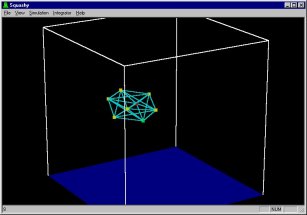
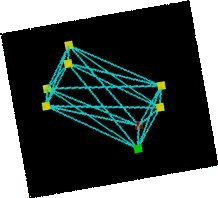
ABSTRACT: We present a method of visually illustrating the stability of numerical integration using computer particle dynamics simulation developed by Jeff Lander and use this method to illustrate several integration techniques including Euler, velocity Verlet, Milne, and Adams-Bashforth-Moulton.
Download the
paper in MS Word Format
Download the paper in RTF
format
Presentation
Download the PowerPoint show (.PPS) '97 format
Code Resources
[New!] My modified source code with additional integrators, data logging, and graphing capabilities is available here:
Download the MSVC project source and executables here
Download the binary executables only here (Windows)
Jeff Lander's original simulation source code:
http://www.darwin3d.com/gdm1999.htm#gdm0399
http://www.darwin3d.com/gdm1999.htm#gdm0399
Paul Barvinko's 2D graphing classes:
References
[1] CHARMM "Molecular Dynamics Tutorial" ONLINE: http://www.ch.embnet.org/MD_tutorial/
[2] Yip, Sidney and Ju Li. (Spring 2002) "Elements of Molecular Dynamics" Statistical Processes and Atomistic Simulations. Massachusetts Institute of Technology. ONLINE: http://long-march.mit.edu/22.53/c2/main.pdf
[3] MacDonald, James. (Spring 2001) "Course Notes for PHYS306: Computational Methods of Physics" University of Delaware. ONLINE: http://www.physics.udel.edu/faculty/macdonald/Ordinary%20Differential%20Equations/Euler's%20Method.htm
[4] Andersen, Hans C. (November 2001) "Accuracy of Integrators for Equations of Motion in Molecular Dynamics" Lecture Notes, Chemistry 276. Stanford University. ONLINE: http://chemweb.stanford.edu/fall2001/chem276/c276_01_lecture11.pdf
[5] Cheney, Ward and David Kincaid. "Multistep Methods" Numerical Mathematics and Computing. Fourth Edition. Brooks/Cole Publishing Company (1999): Pacific Grove, CA. 294-304.
[6] Burden, Richard L. and Douglas J. Faires. "Polynomial Interpolation" Numerical Analysis. Sixth Edition. Pacific Grove, CA: Brooks/Cole Publishing Company, 1997. 136-155.
[7] Lander, Jeff. "Collision Response: Bouncy, Trouncy, Fun" Game Developer Magazine. March, 1999. ONLINE: http://www.gamasutra.com/features/20000208/lander_pfv.htm
SOURCE: http://www.darwin3d.com/gdm1999.htm#gdm0399[8] Lander, Jeff "Lone Game Developer Battles Physics Simulator" Game Developer Magazine. April, 1999. ONLINE: http://www.gamasutra.com/features/20000215/lander_pfv.htm
SOURCE: http://www.darwin3d.com/gdm1999.htm#gdm0399
Other Recommended Resources
Baraff, David and Witkin, Andrew. "Particle System Dynamics" SigGraph 1997 Course Notes.
ONLINE: http://www-2.cs.cmu.edu/~baraff/sigcourse/Franzen, Stefan. (Spring 2000) "CH 795N/ CHE 597B" Statistical Mechanics and Simulations of Fluids and Soft Matter. North Carolina State University. ONLINE: http://chsfpc5.chem.ncsu.edu/CH795N/lecture/V/V.html
Shampine, Lawrence F. and Gordon, M.K. Computer Solution of Ordinary Differential Equations: The Initial Value Problem. W.H. Freemand and Company (1975): San Francisco, CA.
Thanks to...
Thanks to Jeff Lander of Darwin3D for sharing his simulator article and source code, and to Paul Barvinko for his 2D visualization classes.
And special thanks to Dr. Kenneth Wiggins of Walla Walla College for his time, comments and suggestions on this paper and to Dr. Thomas Thompson also of Walla Walla College for his encouragement and help making its presentation possible.